

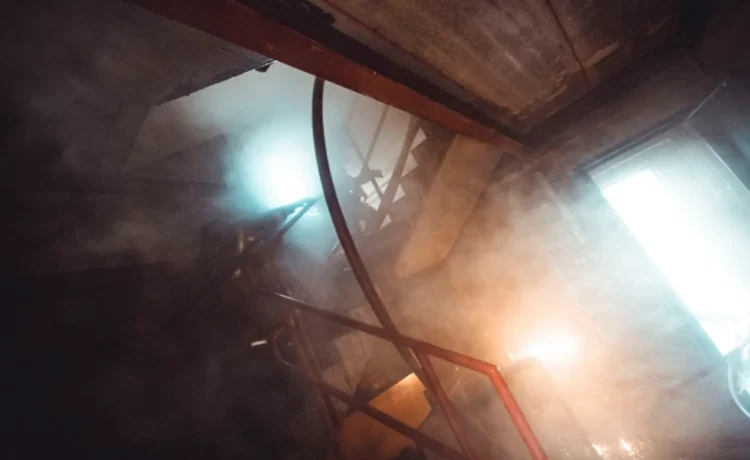
In most building fires, smoke is the bigger threat to life than flames. It spreads faster than fire, fills stairways and corridors, cuts visibility to almost nothing, and carries toxic gases. Whether people can get out safely often depends on how smoke moves through a building in the first few minutes.
That’s why fire engineers in the US and UK increasingly use flow simulation software to model smoke before a building is built. A good simulation shows where smoke will go, how quickly escape routes will become dangerous, and whether smoke control systems will keep them usable long enough for everyone to get out.
Why prescriptive rules aren’t always enough
Most buildings are designed using prescriptive fire safety guidance: set rules for travel distances, stair widths, compartment sizes, and smoke vents. In England, that’s Approved Document B. In the US, it’s the fire and life safety provisions of the building and fire codes, such as the International Building Code and NFPA 101.
Prescriptive rules work well for ordinary buildings. They struggle with unusual ones: tall atriums, shopping centres, airports, stadiums, large open-plan offices, and buildings with complex connected spaces. For those, designers often take a performance-based approach, showing through engineering analysis that the building achieves an acceptable level of safety, even if it departs from the standard rules.
In the UK, BS 7974 sets out a framework for fire safety engineering. In the US, performance-based design is permitted under the model codes, subject to approval by the authority having jurisdiction, and guided by documents such as the SFPE guide to performance-based design and NFPA 92 for smoke control systems.
Simulation is often at the heart of these performance-based designs.
A free tool from NIST
One of the most widely used fire simulation tools is free. The US National Institute of Standards and Technology (NIST) develops the Fire Dynamics Simulator (FDS), a large-eddy simulation code for low-speed flows that focuses on smoke and heat transport from fires. NIST also develops Smokeview, which displays FDS results visually.
FDS is used by fire engineers around the world, including in the UK and US, and has been extensively validated against fire experiments. Several commercial tools add graphical interfaces and modelling aids on top of FDS, while others use different simulation engines. General-purpose fluid simulation packages are also used for some smoke control studies.
What a smoke simulation shows
A fire simulation models a building’s geometry, a design fire with a specified heat release rate and growth, smoke production, ventilation openings, and any smoke control systems such as extract fans, natural vents, and make-up air inlets. It then calculates how smoke, heat, and gases spread through the space over time.
Engineers look at several tenability measures, usually at head height along escape routes:
• Visibility through smoke, since people need to see exits and signs.
• Temperature and radiant heat.
• Concentrations of toxic gases, such as carbon monoxide.
• The height of the smoke layer above floors and walkways.
The result is often expressed as the available safe egress time (ASET), the time before conditions become untenable. This is compared with the required safe egress time (RSET), the time occupants need to detect the fire, respond, and evacuate, usually estimated separately with evacuation modelling. A safe design keeps ASET comfortably above RSET, with a margin for uncertainty.
Common applications
Atriums are one of the most common uses. Smoke rising from a fire on a lower floor can spread across open balconies and walkways on every level above. Simulation helps size smoke extract systems and check that escape routes stay clear.
Shopping centres, transport hubs, and stadiums use simulation to design smoke control across large connected spaces. Car parks use it to design jet fan ventilation systems that clear smoke for firefighters. Tall residential buildings use it to assess smoke control in common corridors and stair lobbies.
Simulation also helps when existing buildings change use or are refurbished, where the original design assumptions no longer apply.
Getting reliable results
Fire simulation is demanding, and the same principles that apply to any flow simulation apply here, with some extra challenges.
The design fire is the biggest assumption. Its size, growth rate, and location shape the results more than almost anything else, and they should be chosen carefully based on the building’s use and fuel loads, using recognised guidance. Mesh resolution matters a great deal for FDS, which needs cells small enough relative to the fire size to capture the fire and smoke plume properly. Boundary conditions, such as door openings, wind effects, and the timing of smoke control activation, need to reflect realistic scenarios.
Sensitivity studies, which test how results change with different fire sizes, locations, and system failures, give confidence that the design isn’t relying on a single optimistic scenario.
The UK regulatory context
After the Grenfell Tower fire, the UK introduced the Building Safety Act 2022 and a new Building Safety Regulator for higher-risk buildings, generally those at least 18 metres or seven storeys tall with at least two residential units. Designs for these buildings go through stricter approval stages, and fire engineering analysis, including simulation, faces closer scrutiny. Clear documentation of assumptions, methods, and limitations is essential.
Questions for clients and design teams
Clients commissioning a performance-based fire design can ask a few practical questions. Which design fires were used, and why? Which software was used, and has it been validated for this kind of scenario? Were sensitivity studies done? How were evacuation times estimated? And has the approving authority, building control in the UK or the authority having jurisdiction in the US, agreed the approach early?
Fire simulation can allow more open, ambitious buildings that are still safe for the people inside. Its results are only as trustworthy as the assumptions behind them, which is why those questions matter.